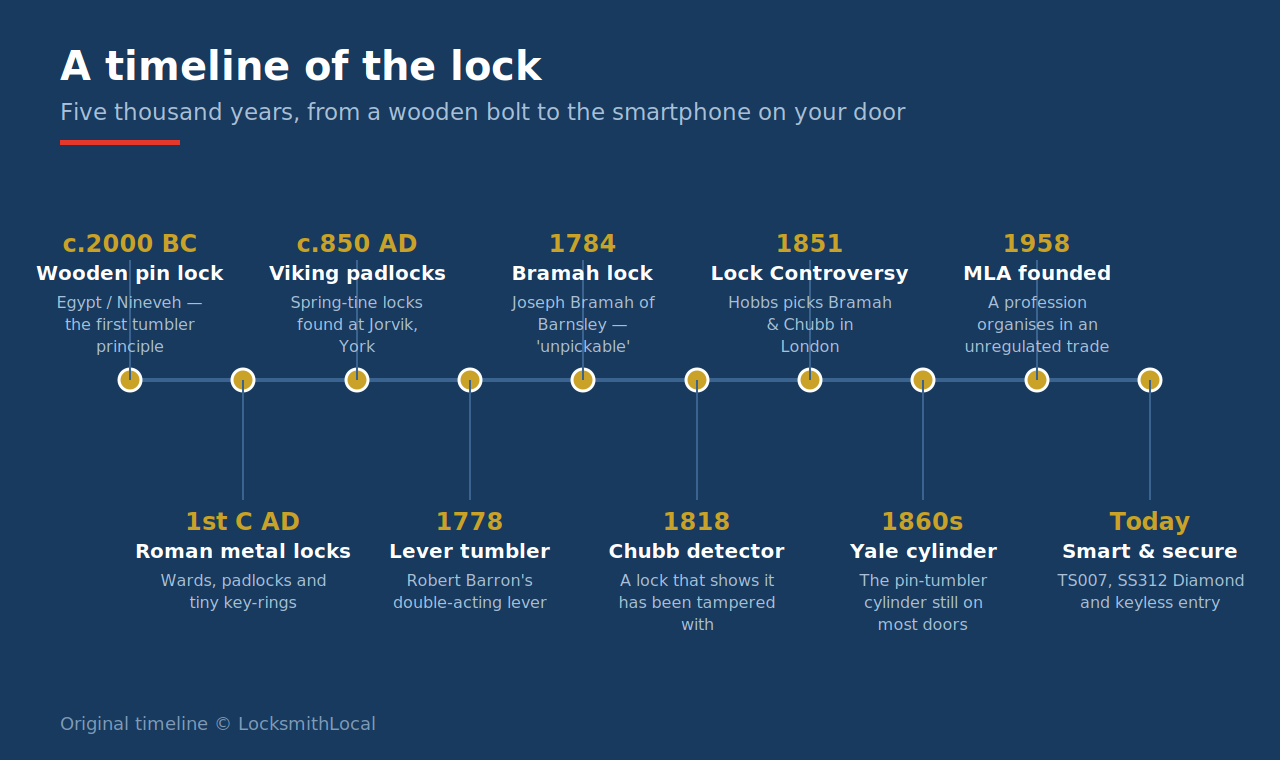
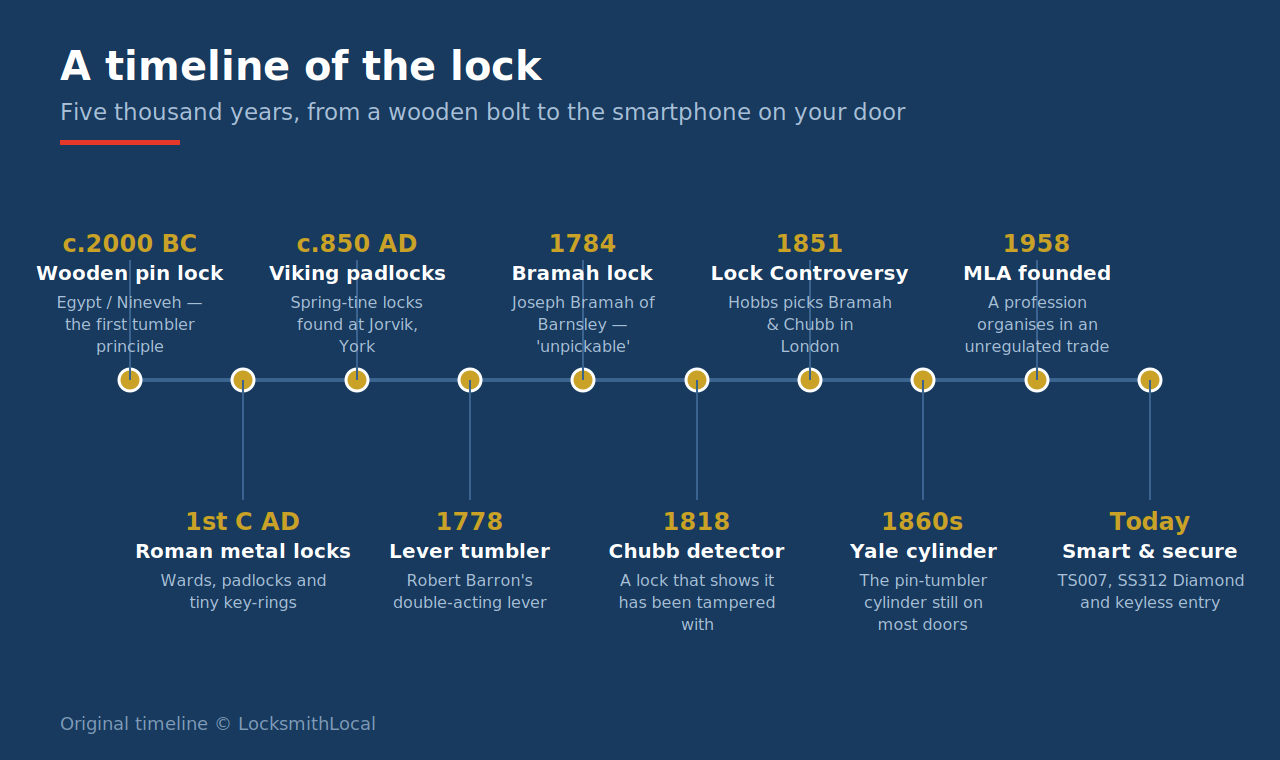
Every door our locksmiths open today is the end of a story that began roughly four thousand years ago, with a bar of wood and a handful of wooden pins. The lock you turn on your way out this morning is a direct descendant of a mechanism a craftsman cut by hand in the ancient Near East — and almost everything that came between, from the Roman padlock to the smart lock on a new-build estate, was a response to the same stubborn human problem: how do you let the right person in and keep the wrong one out?
This is the full story of that problem and the people who spent their lives solving it. It runs from the palace of a vanished empire to a Yorkshire farm, through a public humiliation at the Crystal Palace that changed the trade forever, and on to the standards and accreditations that decide whether the locksmith at your door today actually knows what they are doing. We have written it the way we’d explain it on a job — plainly, with the working detail that matters, and with the things most accounts get wrong put right along the way.
Why a locksmith wrote thisWe fit, repair and open these mechanisms every day. The history isn’t a museum curiosity to us — the lever lock Robert Barron patented in 1778 is still the heart of a British mortice lock we’ll service this week, and the cylinder Linus Yale perfected is on the door you just locked. Understanding where it all came from is part of understanding how to keep you safe.
A lock is really a story about trust
Before there were locks, there was only hiding things and guarding them. A lock is a different idea altogether: it lets you walk away. It stores a decision — this opens for me and not for you — in a physical object, so that a door can stay shut without anyone standing over it. That is why locks appear exactly when and where they do in history: alongside settled communities, stored wealth, and the first need to protect property from people you could no longer personally watch.
Seen that way, the whole history below is one long argument between two crafts — the lockmaker and the lockbreaker — each pushing the other to be cleverer. Every advance you’re about to read about was an answer to an attack, and every attack was an answer to an advance. That argument has never stopped. It is still going on, right now, on doors across the country, and it is the reason a trained locksmith still has a job in an age of smartphones and circuit boards.
The ancient world: a bolt, some pins, and a wooden key
The oldest lock anyone has ever found was discovered in the nineteenth century in the ruins of the palace at Khorsabad, near the ancient Assyrian capital of Nineveh, in what is now northern Iraq. It is reckoned to be around four thousand years old. You will very often see this called an “Egyptian lock,” and that is half right: the design became so widespread in ancient Egypt that its name stuck, but the oldest surviving example is Assyrian. It is a small but important distinction, and one a lot of histories get muddled.
The mechanism itself is the remarkable part, because in principle it is the same one protecting most front doors in Britain today. A heavy wooden bolt held the door shut. Set into the bolt were holes, and above them sat a row of loose wooden pins that dropped down by gravity into those holes, pinning the bolt in place. The key was a large wooden bar — contemporaries compared it to a toothbrush in shape — carrying upright pegs that matched the pattern of the pins. Push the key in, lift the pins clear of the bolt all at once, and the bolt could slide. Take the key away and the pins dropped back. That is the pin-tumbler principle, and when you read about the Yale cylinder later in this guide, keep this wooden ancestor in mind: the idea travelled almost unchanged for four millennia.
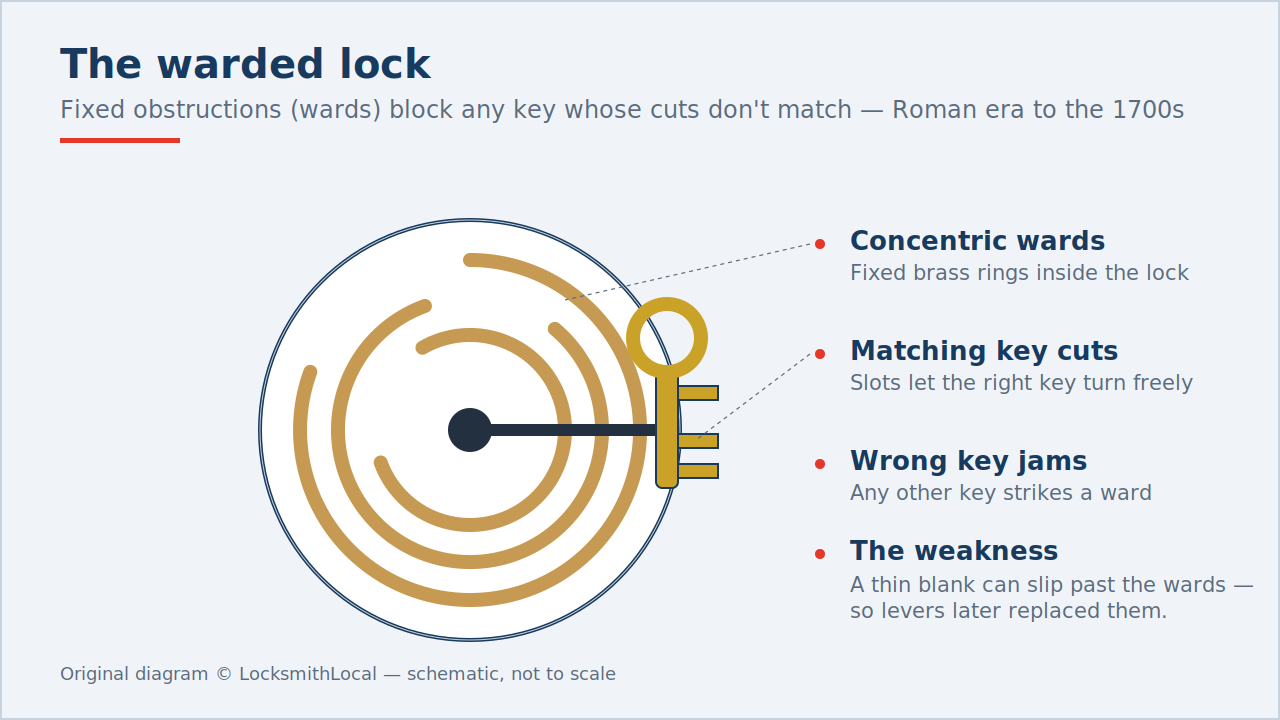
The Romans took the next great step: metal. Roman locksmiths worked in iron and bronze, which let them make mechanisms far smaller and more intricate than wood allowed. They introduced wards — fixed obstructions inside the lock shaped so that only a key with matching cut-outs could turn past them — and they made the first padlocks, portable locks with a hinged or sprung shackle. Roman keys became small enough to wear; wealthy Romans had them made into finger-rings, advertising that they had something worth locking away. The same padlock idea, remarkably, appears independently in ancient China around the same era, made in bronze — one of those moments where two civilisations reach for the same solution without ever meeting.
A Yorkshire footnoteWhen archaeologists excavated the Viking settlement of Jorvik — modern York — they found iron padlocks with spring mechanisms dating to around 850 AD. Security hardware has been part of life in this part of the country for well over a thousand years.
The warded lock and the medieval craft
For more than a thousand years after Rome, one idea dominated European locks: the ward. The warded lock is the design behind the classic image of a key — a long shaft, a round bow to hold, and a flat bit at the end with notches cut into it. Inside the lock sit fixed obstructions arranged in rings or plates; the notches in the key are cut to slip past them. Present the wrong key and its solid bit simply jams against a ward and won’t turn.
This was the age of the locksmith as artist. In the great workshops of Europe — Nuremberg above all — lockmaking became a guild craft of extraordinary skill, producing ornate iron locks for churches, town halls, chests and caskets. Some were masterpieces of decoration with false keyholes to fool a thief, hidden catches, and elaborate cover plates. The medieval treasury chest often carried not one lock but several, sometimes with separate keys held by separate officials, so that no single person could open it alone — the parish chest, with the vicar holding one key and churchwardens the others, is the version that survives in old English churches. There were even fetterlocks, giant shackle-padlocks for securing valuable livestock, in use right up to the nineteenth century.
But there was a problem hiding under all that craftsmanship, and it is one we still see in cheap modern locks: the warded lock looks more secure than it is. The wards only block keys that strike them — so a thin, flat blank that slips past the wards entirely, touching none of them, can often turn the lock. As decoration grew more elaborate, real security stagnated. By the eighteenth century, picking a warded lock was a known and not especially difficult art. The trade was ready for someone to think the whole thing through again — and that someone was British.
The British golden age of precision
Between 1778 and the 1860s, a handful of inventors — most of them British — reinvented the lock from first principles and set the patterns we still use. This is the heart of the story, and it is genuinely a British one.
Robert Barron and the lever, 1778
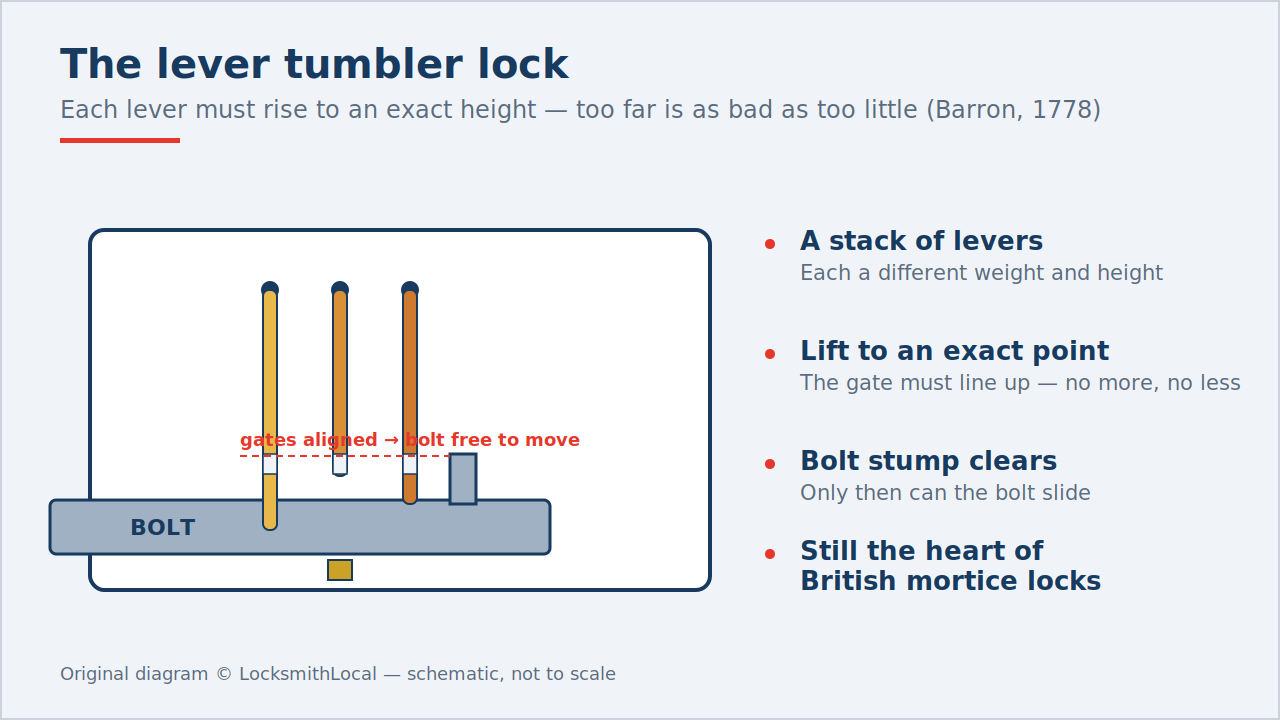
In 1778 a London locksmith named Robert Barron patented the double-acting lever tumbler lock, and it was the first real advance in lock security in centuries. Instead of relying on fixed wards, Barron’s lock used movable levers — pivoting arms that each had to be lifted to one precise height before the bolt could move. The genius was in the word “precise”: lift a lever too far and it was as useless as not lifting it far enough. Each lever had a slot, a gate, and only when every gate lined up exactly could the bolt’s stump slide through and the lock open.
This is not a museum piece. The lever principle Barron described is still the working heart of the British mortice lock — the lock cut into the edge of a wooden front or back door across the country. When you read about a five-lever BS3621 mortice lock today, you are reading about a direct refinement of a 1778 patent. Barron got the idea right the first time.
Joseph Bramah of Barnsley and the “unpickable” lock, 1784
Six years after Barron, a Yorkshireman took the next leap — and this is a part of the story we tell with some local pride. Joseph Bramah was born in 1748 at Stainborough, a village just outside Barnsley, the son of a farmer. An injury to his ankle as a young man ended any future on the land, so he was apprenticed to the village carpenter at Silkstone before walking to London to make his name. He married a woman from Mapplewell, near Barnsley, and went on to become one of the most important engineers of the age. The man who built the most famous lock in British history grew up on the doorstep of the towns we serve.
In 1784 Bramah patented his lock. It abandoned levers entirely for a different idea: a cylindrical key whose end was cut with slots of varying depth, which pushed a ring of sprung wafers down to exactly the right levels to free the mechanism. It was so far beyond the manufacturing precision of the day that Bramah had to invent the tools to make it — work he did with a young blacksmith named Henry Maudslay, whose machine tools went on to help found the entire British engineering industry. The lock was, in other words, a piece of technology that dragged the rest of manufacturing forward to meet it.
Bramah was so confident that in 1790 he mounted a lock in his Piccadilly shop window above a printed challenge: 200 guineas to anyone who could pick it. The board stayed there, unbeaten, for sixty-seven years. That challenge, and the day it was finally answered, set up the single most dramatic episode in the history of the trade.
From the first lever lock to your front door
The principles on this page are still the ones that keep you safe — fitted properly by accredited, DBS-checked locksmiths.
Jeremiah Chubb and the detector lock, 1818
The third great name built on the first two. In 1817 a burglary at the Portsmouth dockyard — a serious matter so soon after the Napoleonic Wars — prompted the British government to offer a reward for a lock that could not be picked. In 1818 Jeremiah Chubb won it with his detector lock. Chubb’s clever addition was not just resistance to picking but detection: if anyone lifted a lever too far, whether a picker or someone trying the wrong key, the lock jammed and stayed jammed, silently recording that it had been interfered with. Only a special regulator movement, or the owner’s own key turned the other way, would reset it. For the first time, a lock could tell you it had been attacked. Chubb went into business with his brother Charles, and the name became a byword for British security that survives to this day.
The Great Lock Controversy of 1851
By the middle of the nineteenth century, British locks ruled the world, and the names Bramah and Chubb stood for security itself. Then, in the summer of 1851, an American locksmith named Alfred Charles Hobbs arrived in London for the Great Exhibition at the Crystal Palace — ostensibly to sell American locks, but with something far more provocative in mind.
Hobbs announced he would pick the Chubb detector lock, considered unpickable. In front of witnesses, he opened it in around twenty-five minutes. Asked to prove it was no fluke, he reset it and did it again in seven. Then he turned to the bigger prize: the Bramah challenge lock that had hung unbeaten in that Piccadilly window for over six decades. Working on and off across some sixteen days, for a total of around fifty hours, Hobbs opened it too — and, after an argument about whether his conditions had been fair, was awarded the 200 guineas.
The shock to British confidence was real and public. As one newspaper put it at the time, the nation had believed its locks as impregnable as Gibraltar. What followed became known as the Great Lock Controversy, and it raised a question the security world still argues about today: is it right to publicly expose the weaknesses of locks people rely on? Hobbs himself argued that it was — that a weakness known only to thieves protects no one, and that exposing flaws forces makers to fix them. It is the exact same debate that surrounds “responsible disclosure” of security flaws in software now. The Victorians were wrestling with it over brass and steel a century and a half ago.
The lesson that still holdsNo lock is unpickable, and any locksmith who tells you otherwise is selling something. The honest goal has never been a perfect lock — it is a lock that resists attack for long enough, and visibly enough, that a burglar moves on. That is the principle behind every modern security rating in this guide.
Linus Yale and the cylinder that conquered the world
While Britain reeled from 1851, the future was taking shape in America — and it was, fittingly, a return to that four-thousand-year-old Assyrian idea. The Yale name covers two men. Linus Yale Senior patented pin-tumbler lock designs in the 1840s. But it was his son, Linus Yale Junior, who in the early 1860s perfected the pin-tumbler cylinder lock and the small, flat, serrated key we all still carry. (You will sometimes see the modern cylinder dated to 1848 and credited to the father; the compact cylinder-and-flat-key design that actually went on to dominate is the son’s, patented around 1861. The two are easy to confuse and frequently are.)
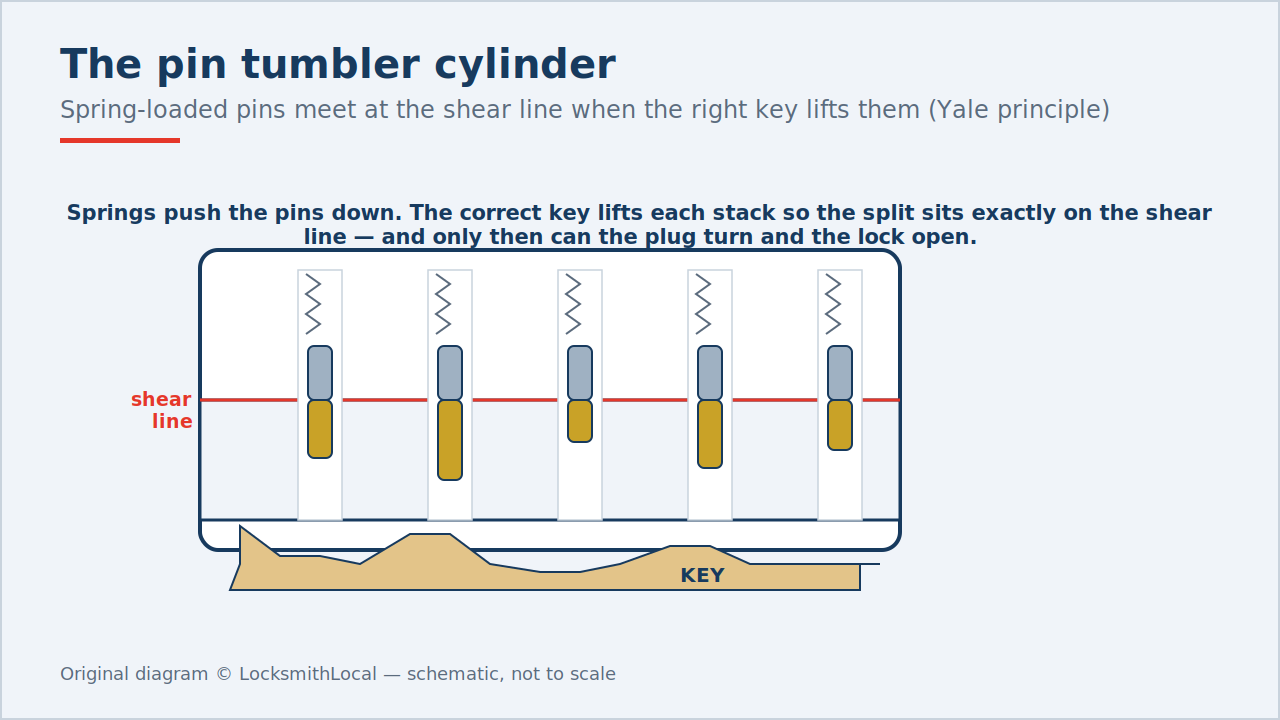
Here is how it works, because it is the lock most people own. Inside the cylinder is a rotating plug, and across it sits a row of small chambers. Each chamber holds two stacked pins — a lower “key” pin and an upper “driver” pin — pushed down by a spring. With no key in, the driver pins bridge the gap between the plug and the surrounding housing, so the plug cannot turn. The correct key lifts each pin stack by exactly the right amount, so that every join between the two pins lines up along the shear line — the boundary between plug and housing. With every stack split precisely on that line, the plug is free to rotate. It is Barron’s “exact height” idea and the ancient pin principle, combined and miniaturised into something that could be mass-produced cheaply. That combination is why it took over the world, and why the euro cylinder in your uPVC door is its direct grandchild.
Safes, banks and the attack–defence arms race
The same century that perfected the door lock also fought a parallel war over the strongroom. As banks and businesses concentrated wealth, the safe became a battlefield of its own. The Chubb brothers patented a burglar-resisting safe in 1835, and firms competed to build boxes that could resist not just picking but drilling, blasting and brute force — while staying fireproof enough to survive the building burning down around them.
The cleverest innovation answered a human attack rather than a mechanical one. Bank robbers had learned they didn’t need to crack a safe at all if they could simply force the manager to open it — so the American inventor James Sargent developed the time lock in the 1870s: a safe that would not open until a preset hour arrived, no matter who turned the dial. There was famously nothing the manager could do, and nothing a kidnapper could gain by making him try. It is a beautiful piece of security thinking — defeating an attack by making the secret itself useless at the wrong time — and the principle survives in the time-delay safes used in shops and banks to this day.
The twentieth century: standards, the mass market and a profession
The twentieth century turned locks from individual craft pieces into mass-produced, standardised products — and brought the insurance industry into the story, which is where modern British security really takes shape. As home insurance spread, insurers needed a way to specify “a proper lock,” and British Standards gave it to them. BS3621 — the thief-resistant lock standard most household policies still refer to — became the benchmark for a door lock that resists drilling and picking and cannot be opened from outside without a key. If your insurer has ever asked whether your locks are “British Standard,” this is what they mean, and we explain exactly how to check yours in our guide to BS3621 British Standard locks.
The century also saw the door itself change. The spread of uPVC and composite doors brought the multipoint locking mechanism — the strip that bolts a door at several points along its length when you lift the handle — and the euro cylinder that operates it, both now found on the majority of British homes. The old debate between mortice and rim locks on wooden doors gave way to a new set of questions about cylinders and mechanisms.
And in 1958, the trade finally organised. A group of locksmiths met in London and founded what became the Master Locksmiths Association, the UK’s oldest and largest locksmith body. The reason it was needed points to something that surprises most people, and it remains true today: locksmithing in the UK is not a regulated profession. There is no government licence, no legal requirement to be trained or checked. Anyone can call themselves a locksmith tomorrow. That single fact — an unregulated trade guarding the nation’s front doors — is the thread that ties this whole history to the choice you make when you pick up the phone today.
The modern era: high security and the digital frontier
The attack-and-defence argument never ended; it just moved on to new ground. When burglars worked out that a standard euro cylinder could be snapped in seconds with cheap tools, the industry answered with anti-snap cylinders and two ratings that now define a good lock: the TS007 star system and the Master Locksmiths Association’s Sold Secure SS312 Diamond standard, both developed in the early 2010s to defeat snapping, drilling, picking and bumping. Lock snapping has fallen since. We cover how to read these marks in our guide to lock security grades.
Then locks went electronic. Smart locks, keypads, keyless entry, app control and biometrics have opened genuinely new convenience — and a genuinely new attack surface, because a lock connected to a network can be attacked over that network as well as at the door. The trade-offs are real enough that we wrote a whole comparison of smart locks versus traditional locks. The car followed the same path: from a simple door lock to the transponder, remote and smart key, where the “lock” is as much code as metal, and the locksmith needs diagnostic equipment alongside picks and cutters.
It is worth pausing on what hasn’t changed. The smart lock on a 2026 front door is still solving Barron’s problem — let the right person in, keep the wrong one out — and it can still be undone by the oldest failure of all: a door left unlocked, a spare key under a mat, a window on the latch. The technology races ahead; the fundamentals don’t move. That is why our advice always comes back to basics done well.
The craft today: from guild apprentice to City & Guilds
So here is where four thousand years arrives. The locksmith standing at your door is the heir to Barron, Bramah, Chubb and Yale — working on mechanisms those men would recognise, with the same goal they had. But unlike the medieval guild apprentice, bound by years of training before he could call himself a master, today’s locksmith works in a trade with no legal floor at all. The skill still has to be learned somewhere; the difference is that nothing forces anyone to learn it.
That is exactly why accreditation matters, and why we are open about ours. Formal qualification — City & Guilds accreditation, the recognised mark of a properly trained locksmith — is the modern version of the guild’s guarantee: proof that the person at your door has been taught the craft and tested on it, rather than simply having bought a van and some picks. (We explain how the different marks compare in MLA vs City & Guilds.) Add a DBS check, real insurance, and a locksmith who is your locksmith rather than an anonymous subcontractor, and you have rebuilt, by choice, the protection that regulation never gave the trade. The history of locksmithing is, in the end, the history of earning trust — and in an unregulated trade, that trust is something a good locksmith has to keep proving, job after job.
Frequently asked questions
Who invented the lock?
No single person did. The oldest known lock is about four thousand years old, found at Khorsabad near Nineveh in ancient Assyria, and works on the pin-tumbler principle. The mechanism was developed independently by several ancient civilisations, and is often called an “Egyptian lock” because it became so widespread there — but the oldest surviving example is Assyrian.
What is the oldest lock in the world?
The oldest known lock was discovered in the ruins of the palace at Khorsabad, near Nineveh, in modern-day Iraq, and is estimated at around four thousand years old. It was made entirely of wood — bolt, pins and key alike — and used the same pin-tumbler principle found in most door locks today.
Who was Joseph Bramah?
Joseph Bramah (1748–1814) was a British inventor born at Stainborough near Barnsley, Yorkshire. In 1784 he patented the “unpickable” Bramah lock and famously offered 200 guineas to anyone who could pick the one in his London shop window. It went unbeaten for sixty-seven years. Bramah was also a major engineer, credited with the hydraulic press and improvements to the flush toilet.
What was the Great Lock Controversy of 1851?
At the Great Exhibition in London in 1851, the American locksmith Alfred Charles Hobbs publicly picked both the Chubb detector lock and the “unpickable” Bramah challenge lock, which had stood unbeaten for over sixty years. It shattered British confidence in its locks and sparked a lasting debate about whether exposing security weaknesses publicly helps or harms — the same argument that surrounds disclosing software vulnerabilities today.
Is the lock on my door really based on such an old design?
Yes. A pin-tumbler cylinder — the most common lock type — uses the same basic principle as that four-thousand-year-old Assyrian lock, refined by Linus Yale in the 1860s. A British mortice lock uses the lever principle Robert Barron patented in 1778. The technology has been miniaturised and mass-produced, but the underlying ideas are genuinely ancient.
Is locksmithing a regulated profession in the UK?
No. There is no government licensing or legal requirement to be trained, qualified or background-checked to work as a locksmith in the UK. This is exactly why voluntary accreditation — such as City & Guilds — a DBS check, and proper insurance matter so much when choosing who to let into your home. Our guide on how to choose a locksmith explains what to look for.
Sources & further reading
This guide was written from a range of reputable, publicly available sources rather than any single account, and cross-checked for the dates and details that histories of locks commonly get wrong. For readers who want to go further, the following are good, legitimately accessible starting points:
- Encyclopædia Britannica — entries on the lock, and on Joseph Bramah, for the ancient origins and the British inventors.
- The Science Museum Group and the Linda Hall Library — for the 1851 Great Exhibition, A. C. Hobbs, and the surviving Bramah challenge lock.
- The Master Locksmiths Association (locksmiths.co.uk) — for the history of the UK trade body and modern security standards.
- British Standards (BSI) and the Door & Hardware Federation — for BS3621, TS007 and the Sold Secure SS312 Diamond standard.
- Contemporary newspaper accounts of the Great Exhibition of 1851 and the Lock Controversy, and standard biographical records for Barron, Bramah, Chubb and Yale.
Everything on this page reflects how these mechanisms actually work in the doors we attend — history told by people who still practise the craft it describes.